

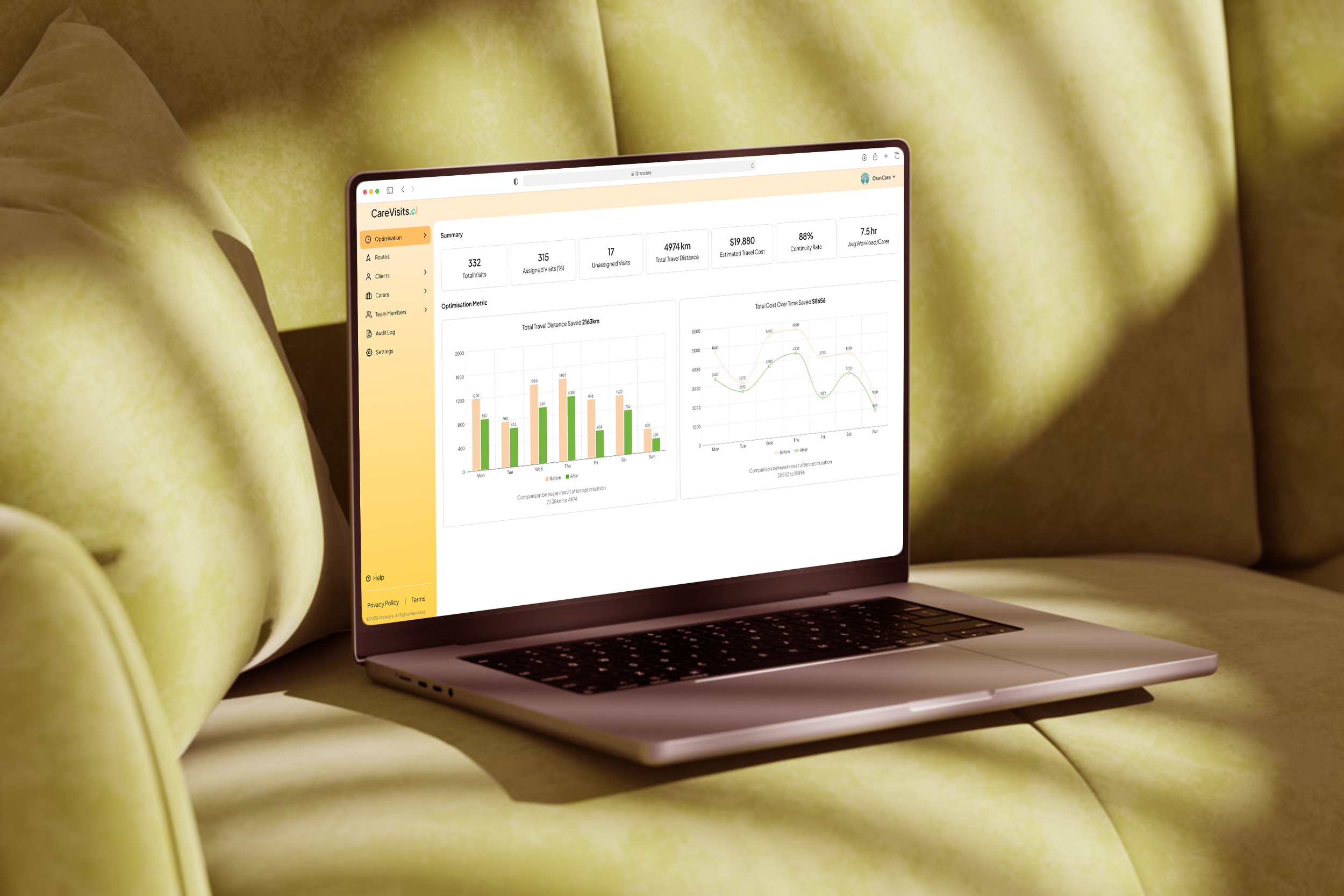
Overview
Managing schedules for carers and clients involves multiple constraints such as availability, location, preferences, and last-minute disruptions. Traditional methods like spreadsheets and calls create inefficiencies, errors, and stress.
This project introduces an intelligent system that automates scheduling, optimizes travel routes, and provides managers with control and transparency. The solution is built around a 3-step workflow:
- Upload data (clients & carers)
- Validate and correct errors
- Generate optimized schedules and routes
The Problem
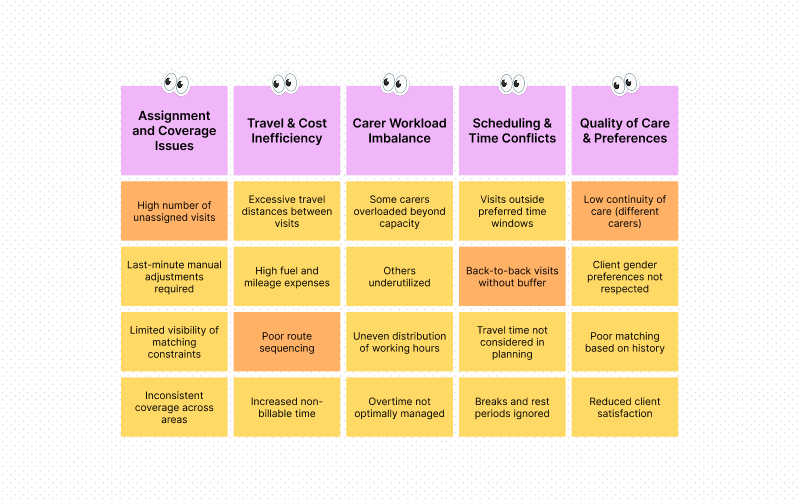
Care scheduling is complex, time-consuming, and error-prone due to manual processes, conflicting constraints, and lack of optimization tools.
Manual Scheduling Overload
Managers spend 8–12 hours weekly managing spreadsheets and fixing errors manually.
Conflicting Requirements
Clients require specific preferences (gender, time), making matching difficult.
Carer Constraints
Availability, location, and leaves create limitations in assignment.
Inefficient Routing
Poor route planning leads to excessive travel time and reduced care quality.
Users & Research
To fully grasp the operational friction, we analyzed the pain points of the three core pillars of the service ecosystem.
Care Manager
Manages scheduling, ensures efficiency, handles disruptions, and balances client and carer needs daily.
- Time-consuming manual scheduling
- Frequent last-minute disruptions
- Data errors in CSV uploads
Carer
Delivers care services, follows schedules, prefers optimized routes, and seeks fair workload distribution.
- Long travel distances
- Unfair workload distribution
- Lack of transparency
Client
Receives care services, values punctuality, consistency, and comfort with assigned carers.
- Late visits
- Inconsistent carers
- Ignored preferences
Strategy & Design Approach
Solution: An intelligent scheduling system that automates allocation while optimizing routes and maintaining flexibility.
Automated Scheduling
Generate optimized schedules based on constraints and preferences.
Smart Route Optimization
Minimize travel time using location-based clustering and mapping.
Data Validation System
Ensure clean, error-free inputs before scheduling occurs.
Manager Control Layer
Allow manual overrides and transparent decision-making.
Interaction & Visual Design
Designing for Clarity, Control, and Efficiency.
The interface prioritizes usability for high-pressure environments. Clear visual hierarchy, real-time feedback, and intuitive controls ensure managers can make quick decisions.
- Table + map hybrid views
- Color-coded alerts and conflicts
- Progress indicators for automation
- Inline editing capabilities
- Minimal cognitive load
Validation & Testing
What Changed: Reduced dependency on spreadsheets, improved scheduling speed, increased accuracy in assignments, better route efficiency, and reduced manual corrections.

"The system is significantly faster and easier to navigate when dealing with sudden cancellations. What used to take 15 phone calls now takes a few clicks."

"I really appreciate the fair workload distribution. The routes finally make physical sense, and I'm no longer driving back and forth across the city all day."

"We noticed a massive improvement in punctuality. It’s so comforting having consistency in who visits us without the constant delays we used to experience."